



Modern Garden Lighting: A Planning Guide from Architectural and Municipal Perspectives
Modern garden lighting is not limited to individual preferences; it must be approached with architectural integrity, public usability, and sustainability in mind. For architects and municipalities, garden lighting is not just an aesthetic element but a strategic decision that directly affects safety, orientation, and the overall quality of public spaces.
When planning modern garden lighting, it is essential to build a well-structured outdoor lighting concept. For a broader understanding, you can explore our garden lighting guide.
In this article, we examine modern garden lighting through the lens of architectural priorities and municipal planning criteria to help guide more effective and long-lasting outdoor lighting decisions.
Table of Contents
- Why Modern Garden Lighting Requires a Different Approach
- How Architects Approach Modern Garden Lighting
- The Importance of Modern Garden Lighting for Municipalities
- Key Criteria for Modern Garden Lighting in Public Spaces
- LED-Based and Energy-Efficient Lighting Approaches
- Integrating Lighting with Landscape and Architecture
- Common Mistakes in Implementation
- Frequently Asked Questions
- Conclusion
Why Modern Garden Lighting Requires a Different Approach
Modern garden lighting is applied across a wide range of environments, from private gardens to public parks and urban squares. However, when considered from an architectural and municipal perspective, it goes beyond personal preference. The main goal is to create a lighting system that enhances safety and navigation without disrupting the identity of the space.
Therefore, garden lighting systems should not be treated as a final touch but as an integral component planned during the early stages of a project.
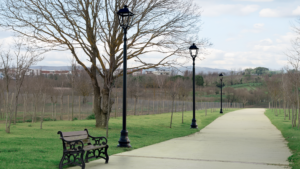
How Architects Approach Modern Garden Lighting
For architects, modern garden lighting is a tool that complements the architectural language of a structure. Light defines volumes and enhances spatial perception. As a result, lighting is evaluated alongside facade and landscape design.
Key elements in the architectural approach include:
- Light distribution that supports the building’s form
- Balanced illumination that avoids glare
- Harmony between natural and artificial elements
- Minimal and clean lighting design
Garden lighting system should enhance readability without overwhelming the design.
The Importance of Modern Garden Lighting for Municipalities
From a municipal perspective, modern garden lighting ensures that public spaces remain safe and accessible after dark. Parks, walking paths, and recreational areas become active and usable environments with proper lighting.
Municipal priorities in garden lighting systems projects include:
- Public safety
- Long-lasting and durable solutions
- Low maintenance and operational costs
- Energy efficiency
This perspective positions garden lighting systems as a public responsibility rather than just a design choice.
Key Criteria for Modern Garden Lighting in Public Spaces
Lighting systems used in public spaces must meet higher standards compared to residential applications. These systems must withstand intensive use and harsh environmental conditions.
Important criteria include:
- Uniform light distribution on walking paths
- Proper placement to eliminate dark spots
- Resistance to vandalism
- Designs that minimize light pollution
These factors ensure a sustainable and safe lighting system in public environments.
LED-Based and Energy-Efficient Lighting Approaches
LED technology has become the foundation of modern garden lighting. Both architects and municipalities prefer LED systems due to their efficiency and long-term advantages.
For more technical insights into outdoor lighting standards and design principles, you can refer to authoritative resources on outdoor lighting.
Key benefits of LED lighting include:
- Low energy consumption
- Long service life
- Reduced maintenance requirements
- Lower carbon footprint
These advantages significantly reduce long-term operational costs, especially in large-scale municipal projects.
Integrating Lighting with Landscape and Architecture
Modern garden lighting should never be considered separately from landscape design. Lighting must be integrated with plants, pathways, and structural elements to create a cohesive environment.
Effective planning involves:
- Positioning lighting elements in harmony with landscape design
- Using natural light tones that match the environment
- Avoiding unnecessary or excessive lighting
This approach ensures that lighting enhances rather than disrupts the visual balance.
Common Mistakes in Implementation
Even in professional projects, certain mistakes are frequently encountered. The most common issues include unplanned placement and excessive lighting. Garden lighting systems should follow the principle of “the right light,” not “more light.”
Typical mistakes include:
- Over-illumination
- Poor alignment with architectural design
- High-maintenance lighting solutions
These errors lead to both aesthetic and economic inefficiencies over time.
Frequently Asked Questions
Why is modern garden lighting important for municipalities?
It enhances public safety and enables the active use of outdoor spaces at night.
Why do architects prefer minimal lighting?
To preserve architectural integrity and create a clean spatial perception.
Are LED systems sufficient for public spaces?
Yes. They provide durability, efficiency, and long-term cost advantages.
When should modern garden lighting be planned?
It should be integrated into the early stages of architectural and landscape design.
Conclusion
Garden lighting systems , when approached from an architectural and municipal perspective, is not just an aesthetic feature but a strategic tool that enhances the quality of public life. Proper planning and energy-efficient systems ensure both user satisfaction and long-term sustainability.
In this context, companies like Ekaldes, which develop engineering-driven solutions for architectural and municipal projects, stand out as reliable partners with durable and project-oriented modern garden lighting systems.