



Public Lighting Poles: Safe and Long-Lasting Solutions for Public Projects
Public lighting poles are essential urban infrastructure components that contribute to safer and more functional roads, parks, squares, pedestrian areas and shared public spaces after dark. However, a successful public lighting project requires more than simply illuminating an area. Mechanical strength, resistance to outdoor conditions, compatibility with lighting fixtures, ease of maintenance and integration with the surrounding urban environment should all be considered together.
For municipalities, public institutions, contractors and engineering companies, choosing the right lighting pole is therefore an important long-term investment decision. Products designed according to the requirements of the project can provide reliable performance while helping reduce maintenance needs throughout their service life.
Ekaldes develops lighting pole solutions for projects of different scales by considering technical requirements, architectural expectations and site conditions together. From road lighting applications to parks and public squares, project-specific solutions can be created for a wide range of public spaces.
Table of Contents
- What Are Public Lighting Poles?
- Why Is the Right Lighting Pole Important in Public Projects?
- Choosing Lighting Poles According to the Application Area
- How Are Technical Specifications Determined?
- The Importance of Material and Surface Protection
- Pole Height and Placement Planning
- Ekaldes Solutions for Public Projects
- Frequently Asked Questions
- Conclusion
What Are Public Lighting Poles?
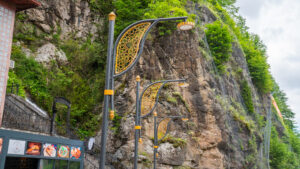
Public lighting poles are structural systems designed to support outdoor lighting fixtures at the required height and help distribute light efficiently throughout a specific area. Depending on the project, a complete lighting pole system may include the pole body, base plate, anchor bolts, brackets, electrical connection sections and lighting fixtures.
These products should not be considered simply as standard street furniture. Every public space has different characteristics, including road width, pedestrian density, environmental conditions, architectural identity and lighting requirements.
For this reason, factors such as pole height, cross-section, material, surface coating and fixture carrying capacity should be determined according to project-specific data. Proper planning contributes to both the technical performance and long-term reliability of the lighting system.
Why Is the Right Lighting Pole Important in Public Projects?
Correctly selected public lighting poles help improve nighttime visibility while contributing to safer and more accessible public spaces. Durable products can also reduce the frequency of maintenance and replacement, helping public institutions control long-term operating costs.
An unsuitable product, on the other hand, may lead to insufficient light distribution, premature corrosion, frequent maintenance requirements or structural problems caused by environmental loads.
Therefore, when selecting lighting poles for public projects, the initial purchase cost should not be the only consideration. Service life, installation requirements, maintenance access, structural durability and compatibility with the lighting fixture should also be evaluated.
The right combination of pole and luminaire allows the lighting infrastructure to operate more efficiently while supporting the overall quality of the project.
Choosing Lighting Poles According to the Application Area
Public lighting poles can be designed with different technical and visual characteristics depending on where they will be installed. Common application areas include:
- Roads, streets and avenues requiring vehicle and pedestrian lighting,
- Parks, gardens and pedestrian paths requiring human-scale illumination,
- Public squares, waterfronts and recreational areas,
- Hospitals, schools and public institution campuses,
- Parking areas, terminals and large open spaces,
- Smart city applications requiring integrated sensors, cameras or communication equipment.
Using the same lighting pole design for every project is not always appropriate. For example, pedestrian areas may require lower poles with controlled light distribution, while major roads and intersections may need taller structures with greater load-bearing capacity.
The characteristics of the application area should therefore be evaluated before the final product configuration is determined.
How Are Technical Specifications Determined?
When preparing specifications for public lighting poles, the design should be evaluated as a complete structural system rather than only in terms of height and appearance.
Important technical criteria include:
- Pole height and body geometry,
- Steel or aluminium material selection,
- Structural resistance to wind loads,
- Number, weight and configuration of luminaires,
- Bracket and arm design,
- Foundation and anchoring details,
- Cable entry and electrical access points,
- Galvanizing and protective coating systems,
- Local climate and environmental conditions.
Technical requirements may vary depending on the location and type of public project. National regulations, standards and applicable lighting requirements should therefore be taken into consideration during project planning. For projects requiring compliance with specific approval processes, TEDAŞ approved lighting poles can provide an important reference point in terms of technical suitability and project requirements.
Compliance with relevant specifications is particularly important for projects involving road lighting and public infrastructure. Technical documentation should be reviewed carefully before production and installation to ensure that both the poles and lighting equipment meet project requirements.
The Importance of Material and Surface Protection
Lighting poles installed outdoors are continuously exposed to rain, humidity, sunlight, temperature changes and environmental pollutants. For this reason, the durability of the pole depends not only on the base material but also on the selected surface protection system.
Galvanized steel lighting poles are commonly preferred because the zinc coating helps protect the steel surface against corrosion. This protection can extend the service life of the product and reduce maintenance requirements, particularly in outdoor infrastructure projects.
Depending on the architectural requirements of the project, electrostatic powder coating can also be applied over the protected surface. This provides additional surface protection while allowing the pole to match urban furniture, municipal colours or surrounding architectural elements.
Ekaldes evaluates surface protection and finishing requirements according to project conditions, helping create lighting poles that combine durability with visual consistency.
Pole Height and Placement Planning
The required height of public lighting poles should not be determined solely according to the size of the area. Road width, luminaire optics, installation angle, surrounding vegetation, pedestrian movement and target illumination levels should all be considered. In addition, general lighting regulations in Türkiye should be reviewed during project planning to ensure that the lighting infrastructure is designed in line with applicable requirements.
Similarly, there is no single standard distance that can be applied between lighting poles in every project. Pole spacing depends on several parameters, including luminaire performance, pole height, road geometry and required light levels.
Lower poles may be suitable for parks and pedestrian paths, while taller systems may be necessary for main roads, intersections and large public areas.
Photometric calculations and site-specific engineering assessments help determine the most appropriate placement. Proper planning can prevent dark spots, excessive illumination and unnecessary pole installation while improving overall lighting efficiency.
Ekaldes Solutions for Public Projects
Ekaldes provides public lighting poles designed for different infrastructure and urban lighting requirements. Solutions can be developed for roads, streets, parks, squares, recreational areas and other public environments.
Pole height, bracket configuration, surface finish, colour and design details can be adapted according to project requirements. This flexibility enables lighting infrastructure to respond to both technical expectations and architectural considerations.
Ekaldes approaches lighting pole projects by considering structural durability, fixture compatibility, installation requirements and urban aesthetics together. LED-compatible pole systems can support energy-efficient lighting applications, while architectural and decorative designs can contribute to a consistent urban identity.
For projects requiring compliance with specific technical standards, appropriate pole configurations can be evaluated according to the applicable specifications and installation conditions.
Frequently Asked Questions
How high should public lighting poles be?
The appropriate pole height depends on the application area. Lower poles may be suitable for parks and pedestrian paths, while taller poles are often required for roads, intersections and larger open spaces. The final height should be determined according to road width, luminaire performance, light distribution and photometric calculations.
What should the distance between lighting poles be?
There is no fixed spacing that applies to every project. The distance between poles depends on pole height, luminaire optics, road geometry and the required illumination level. A lighting calculation should therefore be performed before determining the final layout.
Why are galvanized lighting poles preferred?
Galvanizing helps protect steel surfaces against corrosion caused by outdoor environmental conditions. This can increase the service life of the pole and reduce long-term maintenance requirements, making galvanized poles suitable for many public infrastructure projects.
Can LED luminaires be used on public lighting poles?
Yes. LED luminaires are widely used in roads, parks, squares and other public spaces. However, the selected luminaire should comply with the technical requirements of the project and provide suitable light distribution for the intended application.
What should be considered when selecting a lighting pole?
Material quality, pole height, wind resistance, surface protection, luminaire compatibility, anchoring details and maintenance access should all be evaluated. The project location and applicable technical standards should also be considered before selecting the final product.
Conclusion
Public lighting poles play an important role in creating safe, functional and well-organized urban spaces. Selecting the right material, appropriate pole height, effective surface protection and properly calculated placement can significantly improve the long-term performance of a lighting infrastructure project.
Rather than treating lighting poles as standard standalone products, public projects should evaluate them as part of a complete lighting system. Structural requirements, environmental conditions, luminaire characteristics and installation details should all be considered together.
Ekaldes offers durable, functional and project-oriented lighting pole solutions for roads, parks, squares and other public areas. By combining technical requirements with design flexibility, Ekaldes helps support reliable and long-lasting lighting infrastructure for public projects.